The pituitary gland is a small but mighty gland responsible for the function of most of the other major endocrine glands. This small pea sized gland measuring about 7 mm in size and about 7 grams is the major integration point between the external world and the endocrine system.
Go back in time 10,000 years to the last ice age. Food was scarce, predators roamed large. dangers loomed all around. Survival depended on speed, respnsiveness and cunning. Humans were not the larges or the most fearsome in the animal kingdom. However , humans had a larger brain, and needed a responsive body. The pituitary gland is the link between the brain and your body.
You wake up in the morning, but your body had to be ready to hit the ground running. Your hypothalamus and pituitary gland wakes up a couple of hours prior to wakening to prepare. It increases your hunger, but also churns out glucose from the night before into your system to go and hunt that rabbit.
Stress: Our body needs to deal with stress and the stress may come from the external world ( Seeing or hearing the roar of a predator), the internal mileau, (dealing with an infection) or the brain itself ( feeling sad). This is dealt with at several neuro- endocrine junctions ( eg, pituitary, adrenal gland, )
Growth: The pituitary gland is the gland that integrates the synchronous secretion of hormones to produce growth. In one swift move around the time of puberty, it blocks the action of insulin and diverts energy towards vertical growth. Wish that could just continue!
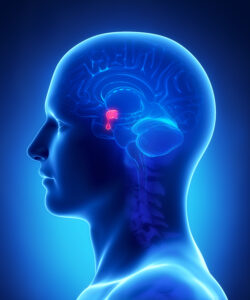
Brain anatomy PITUITARY GLAND – cross section
Reproduction: From sexual drive (Libido) to the production of testosterone, sperm and the menstrual cycle, at the same time checking on the maternal fat stores to ensure that the baby has a decent chance of survival. Fat cells secretes a hormone that is constantly monitored by the hypothalamus and the pituitary.
Lactation: Breast milk production is a very complex process where 4 separate hormones are orchestrated in the correct order to produce milk when the baby suckles on the breast. This is a process takes place over 9 months and all by this tiny pea in the center of your brain.
Metabolism : The pituitary gland calculates the amount of calories the body can burn by getting signals from the fat sores in the body. This then allows it to regulate the thyroid gland. If you are low in fuel ( starvation through the day) or you are going through illness or stress, your body will slow down metabolism to help you survice. It will also accelerate protein burn to save on carbohydrates.. (buring all the furniture to keep the house warm).